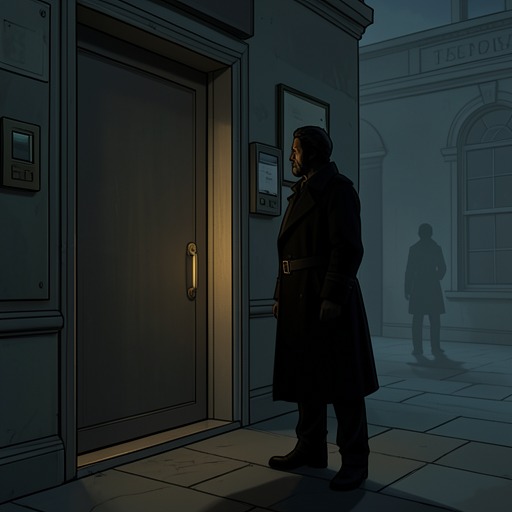
Alison Glenny gives Helen an ultimatum to kill Will
The RadleysAlison Glenny’s ultimatum makes Helen Radley choose between protecting Clara and killing Will Radley. Alison offers to keep Stuart Harper’s death classified as a disappearance, but only if Helen acts before midnight and produces physical confirmation that Will is dead. The bargain is presented as a solution to one killing; in practice, it places Helen’s daughter, husband, former lover, and brother-in-law inside a single coercive demand.
The accusation and its stakes
A few hours before Alison’s visit, Helen had watched the news and found no report that Stuart Harper’s body had been discovered. That absence had allowed her to hope that the book-group members who had raised the matter were mistaken. Alison ends that reprieve by telling Helen that Harper’s body has been found and that the authorities know Clara killed him. Helen cannot immediately answer the accusation, but Alison presses past her denial rather than treating the killing as an uncertain allegation.
The scene thus begins with a reversal in what Helen believes she knows. The lack of a news report had seemed to offer temporary safety; Alison’s announcement establishes that the discovery is known to the people questioning her. Clara’s exposure is not hypothetical, and the proposed bargain is shaped by a specific consequence: whether Harper’s death will remain a murder case or be treated as a missing-person case. The threat to Clara’s safety gives Alison’s offer its force, while Helen’s shock shows how quickly the conversation has moved from private fear to an official demand.
Alison’s authority and arithmetic
Alison identifies herself as the head of the Unnamed Predator Unit, responsible for finding solutions within the vampire community and negotiating. Her role changes the scale of the encounter. Helen realizes that Alison does not regard her as an exceptional individual outside vampire society, but as part of a wider community that can be managed through policy and negotiation. Alison also distinguishes this approach from what Helen remembers hearing about the treatment of known vampires in earlier decades: she presents the Unit’s current method as more calculated and less direct.
That calculation is explicit. Alison says that, for her work, a vampire who has killed once is less serious than one who kills repeatedly, and she describes reducing the situation to numbers as a way of handling its ethical complexity. She identifies Will as the vampire the Unit wants removed from the streets, describing him as a serial killer whose victims may number in the hundreds or thousands. The contrast between Clara’s one known killing and Will’s many alleged victims supplies Alison’s rationale for the exchange: the Unit will treat Clara’s case as a zero in police terms if Helen kills Will.
The terms of the bargain
Alison frames Will’s death as Helen’s only real option if she wants Harper to remain another missing person. She makes Clara’s continued safety conditional on Clara continuing to abstain. Even the apparent protection is therefore limited: it depends on Clara’s conduct and on Helen fulfilling the demand against Will. Alison also requires absolute physical confirmation of Will’s death, so the bargain cannot be satisfied by a claim, an attempted attack, or an uncertain report.
Helen asks why she must act herself and whether Peter can help. Alison rejects both possibilities. Peter must not be involved, and Helen must not tell him about the proposition. Alison explains the restriction through the same arithmetic she has used to assess vampire killings: one person is safer than two. She warns that disclosure would bring serious consequences and says the Unit cannot sanction brothers killing brothers. The prohibition isolates Helen from her husband while specifically preventing Peter from being drawn into violence against his own brother.
Leverage and deadline
Alison then reveals that the Unit knows about Helen’s past relationship with Will. This is not presented as incidental knowledge: Alison says that Peter will learn about it if Helen refuses the proposition. The ultimatum consequently uses two forms of leverage at once. Helen faces the possible consequences of Clara’s known killing, and she is threatened with the disclosure of a relationship that could damage her marriage. The evidence establishes Alison’s threat, but not how Peter would respond or whether Helen accepts the bargain.
The terms are reinforced by surveillance. Alison says that people will be watching throughout and that attempts to bend the rules or find another way out will fail. When Helen asks when she must act, Alison sets the deadline at midnight that same night. The compressed timetable leaves little room for consultation, while the surveillance warning denies her any clearly safe alternative route. The scene ends with the deadline made concrete: Helen is not being asked to consider an eventual course of action, but to confront the demand that night.
As an event, the ultimatum brings the novel’s competing loyalties into direct conflict without resolving them. Alison casts the proposal as pragmatic harm reduction, weighing a single killing against Will’s much larger record and offering Clara conditional protection. But its method is personal coercion: Helen is ordered to kill her former lover, forbidden to confide in her husband, and threatened with the exposure of their past. The outcome remains unsettled here. What is fixed is the choice Alison imposes and the midnight limit within which Helen must face it.